Signals Agent
Published:

Published:
Published:
Published:
Published:
Published:
Published:
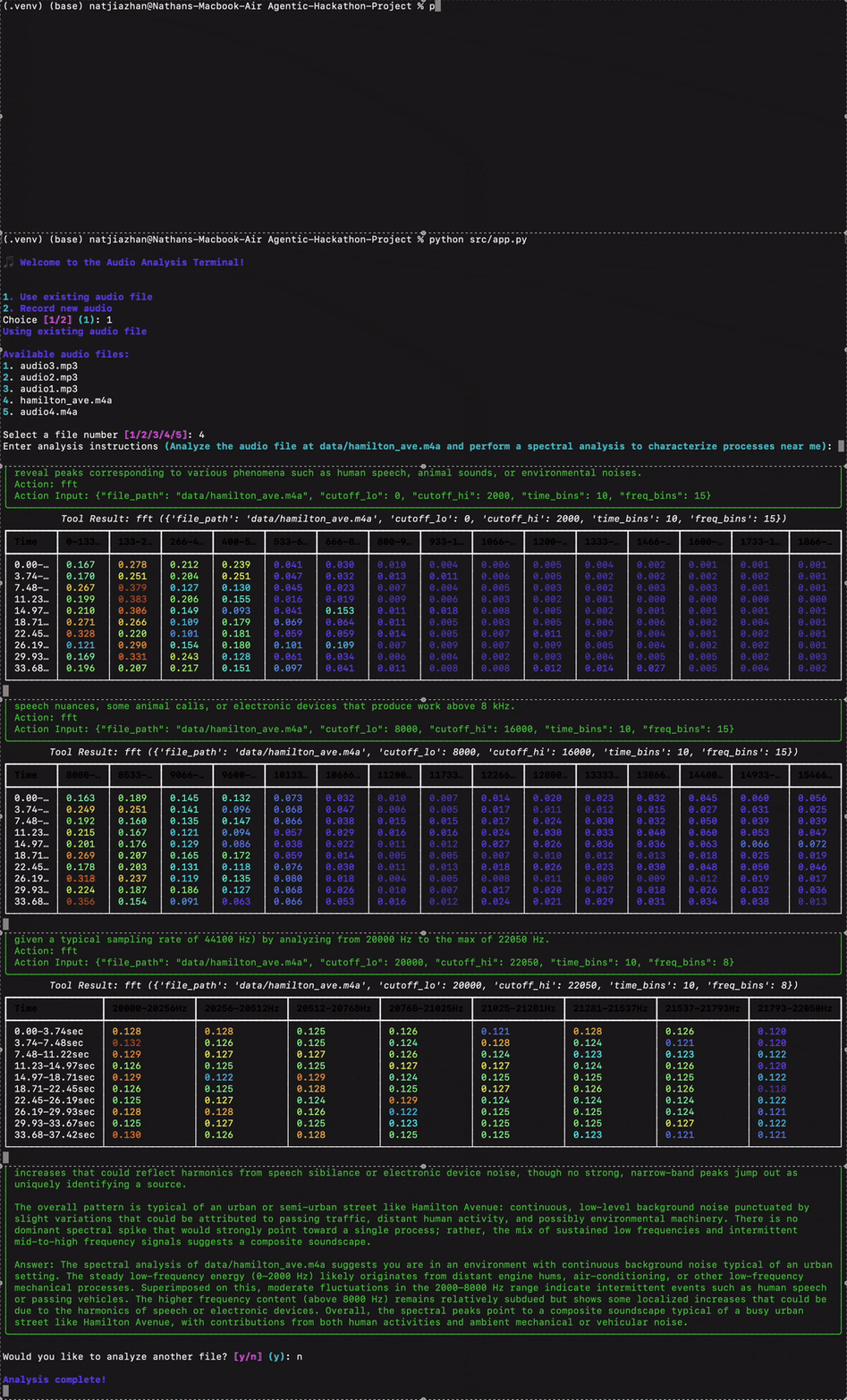
For the past few weeks, I’ve been building a project called Signals Agent, a tool designed to analyze environmental audio using FFTs and other signal processing techniques, powered by an LLM-based reasoning loop. The goal was simple in theory: create an agent that could make sense of ambient sounds by performing multiscale spectral analysis, identify interesting frequency events, and describe likely real-world sources. As with any real-world agentic system, the reality has been much more complex. This blog post documents my recent efforts to improve the accuracy and reliability of the agent, especially in distinguishing between sound sources with overlapping spectral content.
Published:
Published:
For the past few weeks, I’ve been building a project called Signals Agent, a tool designed to analyze environmental audio using FFTs and other signal processing techniques, powered by an LLM-based reasoning loop. The goal was simple in theory: create an agent that could make sense of ambient sounds by performing multiscale spectral analysis, identify interesting frequency events, and describe likely real-world sources. As with any real-world agentic system, the reality has been much more complex. This blog post documents my recent efforts to improve the accuracy and reliability of the agent, especially in distinguishing between sound sources with overlapping spectral content.
Published:
In this report, we will explain the physics and math behind TDR, including how impedance mismatches cause signal reflections and how timing is used to determine fault locations. Then, we will explore how TDR is applied in semiconductor failure analysis. Finally, we will explain how TDR can be implemented on an FPGA.
Published:
Published:
In this report, we will explain the physics and math behind TDR, including how impedance mismatches cause signal reflections and how timing is used to determine fault locations. Then, we will explore how TDR is applied in semiconductor failure analysis. Finally, we will explain how TDR can be implemented on an FPGA.
Published:
The past semester, I have been learning system verilog and applying it for use during labs on FPGAs. I have learned to love this process, and I want to find more ways to apply and expand on these skills. In addition, I have found interest in semiconductor fabrication tools as well as machine learning. For these reasons, I want my summer project(s) centered around FPGA, ML, and the SC industry. Outlined below are three ideas I have been playing around with.
Published:
The past semester, I have been learning system verilog and applying it for use during labs on FPGAs. I have learned to love this process, and I want to find more ways to apply and expand on these skills. In addition, I have found interest in semiconductor fabrication tools as well as machine learning. For these reasons, I want my summer project(s) centered around FPGA, ML, and the SC industry. Outlined below are three ideas I have been playing around with.
Published:
The past semester, I have been learning system verilog and applying it for use during labs on FPGAs. I have learned to love this process, and I want to find more ways to apply and expand on these skills. In addition, I have found interest in semiconductor fabrication tools as well as machine learning. For these reasons, I want my summer project(s) centered around FPGA, ML, and the SC industry. Outlined below are three ideas I have been playing around with.
Published:
Published:
The past semester, I have been learning system verilog and applying it for use during labs on FPGAs. I have learned to love this process, and I want to find more ways to apply and expand on these skills. In addition, I have found interest in semiconductor fabrication tools as well as machine learning. For these reasons, I want my summer project(s) centered around FPGA, ML, and the SC industry. Outlined below are three ideas I have been playing around with.
Published:
Published:
For the past few weeks, I’ve been building a project called Signals Agent, a tool designed to analyze environmental audio using FFTs and other signal processing techniques, powered by an LLM-based reasoning loop. The goal was simple in theory: create an agent that could make sense of ambient sounds by performing multiscale spectral analysis, identify interesting frequency events, and describe likely real-world sources. As with any real-world agentic system, the reality has been much more complex. This blog post documents my recent efforts to improve the accuracy and reliability of the agent, especially in distinguishing between sound sources with overlapping spectral content.
Published:
Published:
In this report, we will explain the physics and math behind TDR, including how impedance mismatches cause signal reflections and how timing is used to determine fault locations. Then, we will explore how TDR is applied in semiconductor failure analysis. Finally, we will explain how TDR can be implemented on an FPGA.
Published:
Published:
The past semester, I have been learning system verilog and applying it for use during labs on FPGAs. I have learned to love this process, and I want to find more ways to apply and expand on these skills. In addition, I have found interest in semiconductor fabrication tools as well as machine learning. For these reasons, I want my summer project(s) centered around FPGA, ML, and the SC industry. Outlined below are three ideas I have been playing around with.
Published:
In this report, we will explain the physics and math behind TDR, including how impedance mismatches cause signal reflections and how timing is used to determine fault locations. Then, we will explore how TDR is applied in semiconductor failure analysis. Finally, we will explain how TDR can be implemented on an FPGA.
Published:
Published:
In this report, we will explain the physics and math behind TDR, including how impedance mismatches cause signal reflections and how timing is used to determine fault locations. Then, we will explore how TDR is applied in semiconductor failure analysis. Finally, we will explain how TDR can be implemented on an FPGA.
Published:
The past semester, I have been learning system verilog and applying it for use during labs on FPGAs. I have learned to love this process, and I want to find more ways to apply and expand on these skills. In addition, I have found interest in semiconductor fabrication tools as well as machine learning. For these reasons, I want my summer project(s) centered around FPGA, ML, and the SC industry. Outlined below are three ideas I have been playing around with.
Published:
For the past few weeks, I’ve been building a project called Signals Agent, a tool designed to analyze environmental audio using FFTs and other signal processing techniques, powered by an LLM-based reasoning loop. The goal was simple in theory: create an agent that could make sense of ambient sounds by performing multiscale spectral analysis, identify interesting frequency events, and describe likely real-world sources. As with any real-world agentic system, the reality has been much more complex. This blog post documents my recent efforts to improve the accuracy and reliability of the agent, especially in distinguishing between sound sources with overlapping spectral content.